Why does a conventional EMS-style manufacturer or a generalist EPC contractor get any data-centre work at all, if the hard half is this demanding? Because a large share of what a data-centre developer buys is still catalog equipment — a distribution transformer built to a standard published specification, a run of structured cabling to an industry-standard certification, a civil shell built to a generic industrial building code. None of this requires the buyer or the supplier to solve a novel engineering problem; it requires meeting a specification someone else has already written. This is why a broad population of India-listed companies can credibly claim "data centres" as a served sector without any of them needing to hold a genuinely scarce capability.
The alternative — custom engineering — is a purpose-built transformer/GIS substation, a rack-level power-distribution and precision-cooling design engineered around one specific hyperscale campus's exact load profile, redundancy target and physical footprint. This is a smaller, harder door, and — reading across this report's twenty companies in §9 — the evidence is genuinely mixed on how many of them have walked through it: Voltamp's Q1 FY27 order mix, Hitachi Energy's and ABB India's own management commentary on hyperscaler-specific "rate contracts" and campus-level "grid-to-rack" engineering all point to real custom-engineering content behind at least some of this report's power-equipment order books; the construction and cabling names, by contrast, sit closer to the catalog end of this spectrum, competing substantially on price against other qualified bidders for broadly similar specifications.
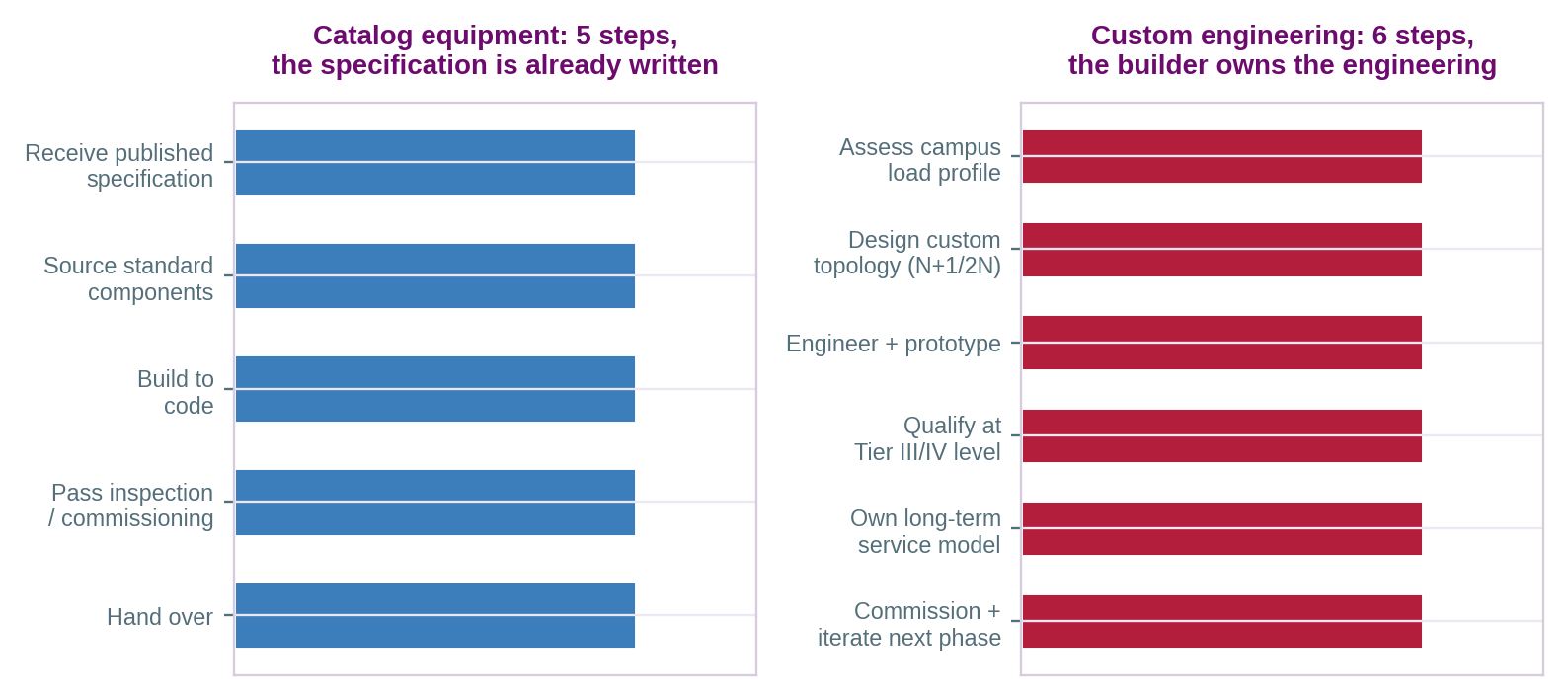
When a company report later in this document describes a company as a data-centre "beneficiary" purely on the strength of sell-side analyst commentary or a company website listing "data centres" as a served sector, read that as: likely catalog-equipment or competitively-bid work, margin thin and not obviously protected. When it says a company holds a named hyperscaler rate contract, a disclosed order-mix statistic, or a genuinely differentiated engineering capability the specification itself does not commoditise, read that as closer to the hard half — and worth asking whether the current valuation already assumes that differentiation persists.