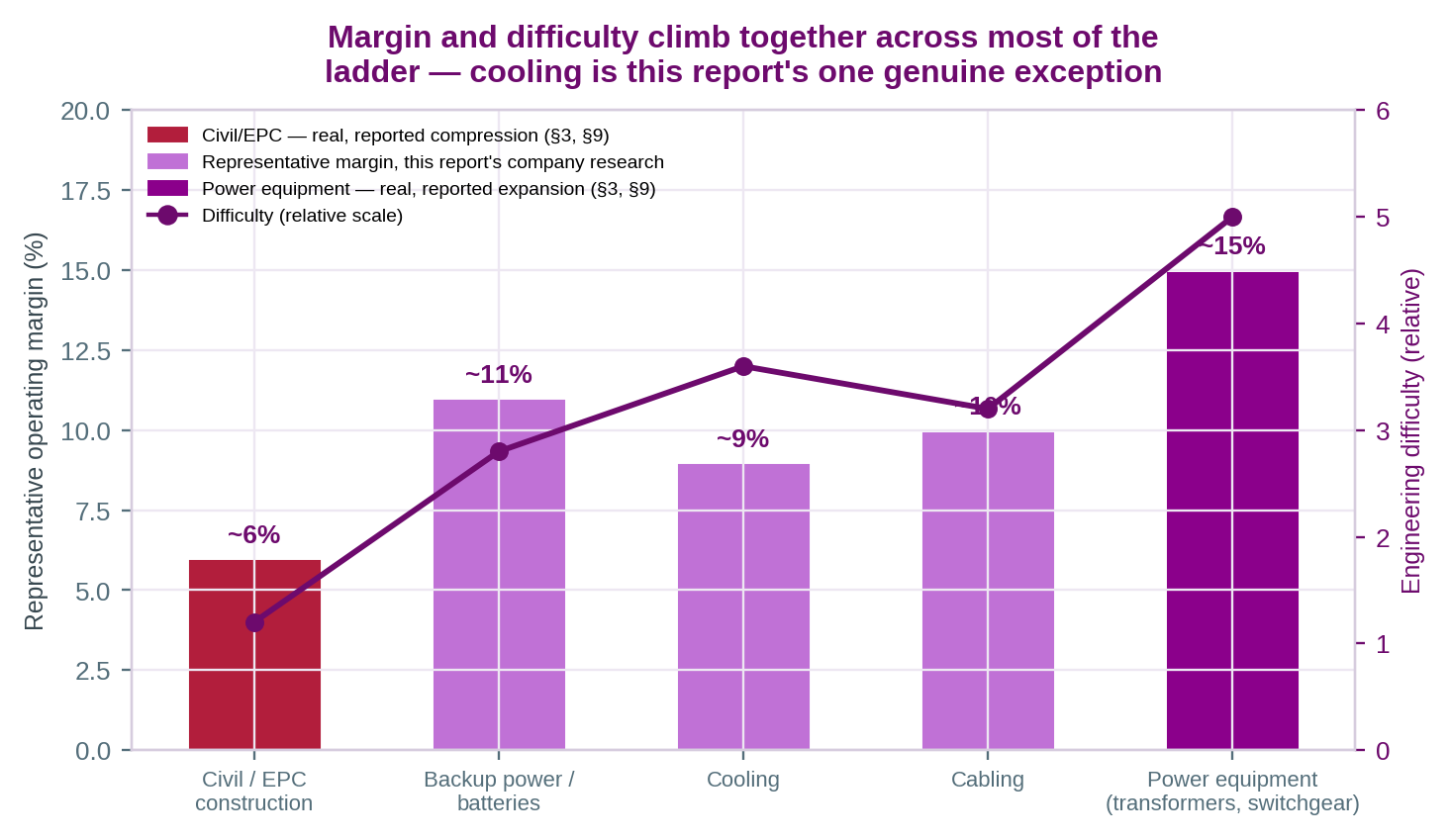
This report's twenty companies sort into five sub-categories: civil construction/EPC, cabling, cooling, backup power/batteries, and power equipment (transformers, switchgear, grid technology). Reading this report's own company research (§9) in order from the most commodity-priced to the most engineered layer produces a reasonably clean margin gradient — but not a perfectly monotonic one, and the exceptions matter as much as the pattern.
The single clearest finding of this report's screening research is not about which company captures the most value — it is that one entire, highly visible product category has no India-listed pure-play holder at all. Precision cooling (CRAC/CRAH units) and data-centre-grade UPS systems — the exact equipment behind the globally recognisable APC, Vertiv and Stulz brands — are supplied in India almost entirely by unlisted multinational subsidiaries: Schneider Electric India Pvt Ltd (which houses the APC brand, and is a separate, unlisted entity from the listed Schneider Electric Infrastructure Ltd covered in this report — see that company's own report for the distinction), Vertiv India, Delta Electronics India, and specialist precision-cooling names like Airedale, Stulz and Rittal. A public-markets investor simply cannot buy this specific, highly visible layer of the data-centre stack on the Indian exchanges today. This is the opposite kind of finding from the sister report's OSAT-packaging exception — that report found a low-visibility layer holding outsized value; this report finds a high-visibility layer holding no listed value at all — and it is exactly the kind of structural absence a market-size headline would never surface.
Several companies in this report's own cooling category (Blue Star, Voltas, Thermax) supply the civil, electro-mechanical and chiller-plant side of a data centre's thermal system — real, disclosed businesses — but none of them is the precision-CRAC/UPS layer described above. Do not read "cooling company in this report" as "exposure to the APC/Vertiv-style UPS and precision-cooling market" — they are adjacent, overlapping in a facility's overall mechanical scope, but distinct businesses.
| Sub-category | Where the margin evidence points | Companies in §9 |
|---|---|---|
| Power equipment (transformers, switchgear, grid tech) | Most consistently expanding/scarce — Voltamp's order-mix data, Hitachi Energy's and ABB India's own management commentary on rate contracts and backlog growth | Voltamp, Hitachi Energy India, ABB India, GE Vernova T&D, Siemens Ltd, Siemens Energy India, Schneider Electric Infrastructure |
| Cabling | Real product differentiation, generally stable-to-strong margins — a genuine middle rung, not a commodity one | Sterlite Technologies, Polycab, KEI Industries, Finolex Cables |
| Cooling | Mixed — real engineered capability, but this report's own evidence found margin volatility and even outright collapse at more than one name | Blue Star, Voltas, Thermax |
| Backup power / batteries | Thin evidence of DC-specific pricing power; treat as a secondary, not primary, DC angle | Amara Raja Energy & Mobility |
| Civil construction / EPC | Most consistently under pressure — this report's clearest, most repeatedly confirmed margin-compression evidence | L&T, Techno Electric & Engineering, KEC International, Kalpataru Projects International, Ahluwalia Contracts |
Source: Dart Consultants, from each company's own report in this document (§9/Part 4). A company's placement reflects where its DC-relevant business sits, not necessarily its entire revenue base — several of these companies are diversified conglomerates for which data-centre work is one line among many; see §8.