One large, genuinely fast-growing demand cycle sits underneath this report, and — just as in the sister compute-stack primer — published estimates of its actual size disagree by a wide enough margin that reporting only one number, without showing the spread, would misrepresent how settled this market-sizing question actually is.
| Metric | What is reported |
|---|---|
| Operational DC capacity (2025) | Crossed ~1,700MW in 2025, with ~440MW added during the year; one dataset separately cites ~1,530MW operational as of 9M-2025 with ~260MW added — two overlapping, not fully reconciled counts |
| 2026 growth | Total stock across major cities projected +~30% YoY, with ~500MW of fresh supply (CBRE) |
| H1 2026 absorption | 101MW (JLL), over 20% above the 3-year average; hyperscale pre-committed capacity made up 82% of that absorption — the great majority of new capacity changing hands today is locked in years before it is actually switched on |
| Facility sizing trend | Individual facility sizes growing from ~20MW blocks toward 50MW+ blocks — each step up mechanically multiplies the power-equipment and cooling-plant order size per facility |
Source: Dart Consultants, compiled from CBRE and JLL India data-centre market research as aggregated in this report's own primer-level research, checked September 2026.
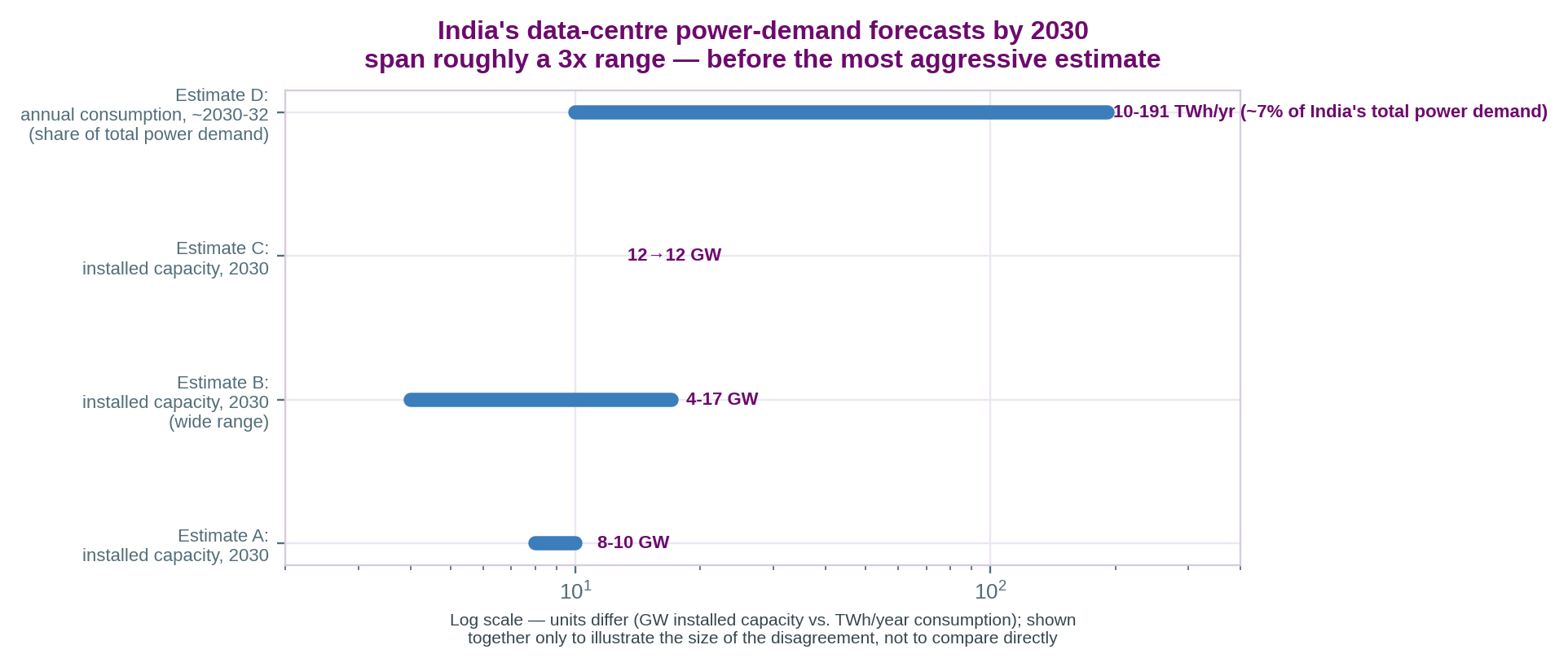
Every published "India data-centre power demand by 2030" figure in circulation uses a different scope and a different confidence level, and headlines routinely quote whichever is largest without saying so:
These four estimates are not four measurements converging on one truth — they use different base years, different scopes (installed capacity vs. energy consumption) and different confidence levels. Treat the spread itself as the finding, exactly as this report's sister primer treats its own India AI-market and power-demand dispersion charts.
Data-centre power demand is a fast-growing but still small slice of a much larger national buildout: India's peak power demand reached roughly 250GW in 2024 (up ~54% since 2017), and total installed capacity is projected to rise from ~475GW (March 2025) to 700GW-plus by March 2030, with renewable energy sources accounting for the large majority of that addition. This matters directly for this report's power-equipment companies: transformer, switchgear and grid-technology demand from the broader renewable-integration and grid-strengthening cycle is, in most of these companies' own disclosures, at least as large a demand driver as data centres specifically — data-centre demand is riding on top of, not separate from, this larger grid investment cycle.
Because data-centre and broader grid/renewable-integration demand both fall on the same power-equipment companies at the same time, a strong order book at, say, Hitachi Energy India or GE Vernova T&D India cannot be read as pure evidence of data-centre-specific pricing power without checking what the company itself actually attributes that order growth to. This report's own company research (§9) does this attribution explicitly, company by company, rather than assuming every rupee of order growth at a power-equipment company is a data-centre rupee.